Wuthering Heights, xvii
The ambiguity of Isabella:
“I’ve recovered from my first desire to be killed by him. I’d rather he’d kill himself! He has extinguished my love effectually, and so I’m at my ease. I can recollect yet how I loved him; and can dimly imagine that I could still be loving him, if – no, no!” (143).
“…I’d be glad of a retaliation that wouldn’t recoil on myself; but treachery and violence are spears pointed at both ends – they wound those who resort to them, worse than their enemies” (145).


Wuthering Heights, xvi
“Poor wretch!” I thought; “you have a heart and nerves the same as your brother men! Why should you be so anxious to conceal them? Your pride cannot blind God! You tempt Him to ring them, till He forces a cry of humiliation!”
Catherine dies. Catherine is born.
Atmospherics: how Heathcliff is dew-soaked to match his tears, and is so still the birds build a nest in the tree quite close to him. Birds building a nest may be symbolic, yes?
Ousel
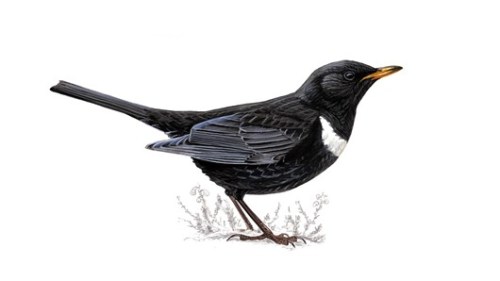
Wuthering Heights, xv
Heathcliff sneaks a visit while Edgar and servants are at church to see How ill Catherine is, and is dismayed to see “no prospect of ultimate recovery is there – she was fated, sure to die” (132).
“Vindictive,” she asks him how long he means to go on living after she is dead. Here, the characters finally trade speeches of the depth of love — indeed, laced with the symbolism of the torments of hell — to the ears of us readers (133).
Catherine is described in ghostly, perhaps vampiric imagery, Heathcliff in animal, perhaps demonic; the novel is in the gothic genre, indeed.
Cathy refuses to let go despite Nell’s warning of Linton’s approach. Heathcliff hands over an unconscious Catherine to Edgar’s arms.
Wuthering Heights, xiv
Nell visits the Heights at Isabella’s request. The latter is hoping for a letter from Edgar, but Edgar has disowned her.
Heathcliff regales Nell with an account of how the marriage is going: he delights in degrading Isabella and marveling at how she “crawls back.” Perhaps one line the best sums it up: “I have no pity! The worms writhe, the more I want to crush out their entrails! It is a moral teething, and I grind with greater energy, in proportion to the increase of pain” (128).
Isabella counters that she had tried to leave at his invitation, and dares not try again for the insinuated abuse that resulted from the attempt. Heathcliff refers to her as property and her guardian, and refers to her as “child.”
Heathcliff threatens Nell with confinement unless she agrees to facilitate a visit to Cathy. He threatens otherwise to overpower Linton and hold off servants with pistols if need be.
Nell weighs the consequences, and acquiesces.
Wuthering Heights, xiii
A “brain fever.” Even though she looks better, when Edgar wishes she could be outside for the health benefits, she says she will be in those hills but one more time.
A letter from Isabella. “The second question, I have great interest in; it is this – is Mr. Heathcliff a man?” (115)
Her description of Hindley, “His eyes, too, were like a ghostly Catherine’s, with all their beauty annihilated” (117). You can guess how that will end, seeing as Heathcliff acquires the Heights…
A tiger or a venomous serpent could not rouse terror in me equal to that which he wakens.
Penistone Crags
Perhaps the inspiration for the ficticious Penistone Crag is Ponden Kirk.
Photo credit to the site Megalithix on WordPress. 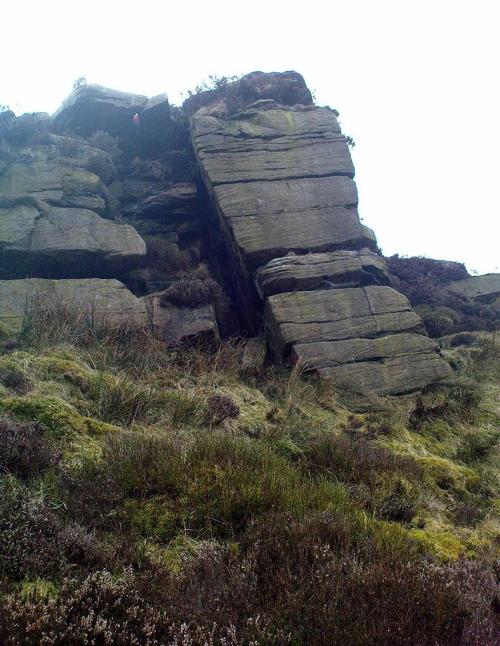
Wuthering Heights, xii
In this chapter, Catherine’s delusions that recall her time on the moors with Heathcliff allow us to infer some of the things they did in childhood together.
Despite Catherine’s “ghastly countenance and strange exaggerated manner,” Nell does not communicate her “I am dying” sentiments to Edgar.
Catherine tears the pillow and arranges feathers: The lapwing, and her story about Heathcliff setting traps for birds on Penistone Crag (105).
elf-bolts It is believed that if one wandered incautiously, or trespassed in areas belonging to the fairies, they might shoot you with one of their invisible arrows. In turn you would sicken and die. (I was elf-shot as I took a shortcut off the path to Glastonbury Tor: by and by, I will die…)
The black press.
Catherine recalls braving Gimmerton Kirk with Heathcliff to call the ghosts.
“I wish I were out of doors – I wish I were a girl again, half savage, hardy, and free” (107). Too late, Nell realizes this is serious, and almost at the moment Edgar enters, discovers his wife’s condition, and is furious.
In running for the doctor, Nell finds Isabella’s dog hanged from a gate post, and imagines hearing horse hoofs racing away. Her fears come true and realizing that Isabella and Heathcliff have run off together. Edgar’s response is that he has not disowned her, but she him.
Wuthering Heights, xi
Nell meets Hareton after an absence, and is hurled-at literally and literally. She gathers much from this brief interrogation.
Upon Heathcliff’s next visit to Thrushcross Grange, he makes the move on Isabella: Catherine says, “I’m not jealous of you, I’m jealous for you” (97).
“What new phase of character is this?” (97). Heathcliff reveals his intention with him the following speech.
blackguard
“Cathy, this lamb of yours threatens like a bull!” (99). The “fight”: “I’d rather see Edgar at bay than you.”
Edgar’s ultimatum: him or me.
Catherine’s fit puts Edgar into a fright; Nell rightly warns him that she is acting, and that giving in will not be the best of responses…
Wuthering Heights, x
Lockwood guesses at Heathcliff’s self-education in his absence.
sizar’s seat
Earn honors by drawing blood refers to soldiering.
Making a fortune more promptly on the English highways refers to Highwaymen.
Note Cathy’s reception of Heathcliff, and the physical description of Heathcliff next to Linton harkens back to the soul comparisons of chapter nine; the physical mirrors the internal.
Notice that Nelly Dean is the voice of reason for Catherine. In a sense, Nell can be thought of as fulfilling functions of the Greek chorus.
“Good night — I’m an angel!” An angel of hell, maybe.
Do you feel Catherine is sincere in her warning to Isabella by describing Heathcliff, “an unreclaimed creature, without refinement, without cultivation; an arid wilderness of furze and whinstone” (89)? He’d crush you like a sparrow’s egg.
WH is a work that epitomizes atmospherics. (When I was a kid in the sixties, by this time of 2017, science-fiction promised us transporters that would allow us to materialize elsewhere: I wish this were the case, and that we could take a field trip to these moors: the wind and the gritty mist and the roughness of gorse and the jutting stones would bring this home quickly to your skin and blood into the knowing.)
“You are worse than twenty foes, you poisonous friend” (90).
Nell attempts to corroborate the character assessment to Isabella, who will have none of it: we know where this is going, hey? One order of situational irony, coming right up: served hot, or cold?
“He is a bird of ill omen…Honest people don’t hide their deeds.”
Heathcliff looks at Isabella as if she was a centipede from the Indies, but soon notes “She’s her brothers heir, is she not?” (93). We guess at his motive, even if we do not recall Lockwood’s wondering how Heathcliff became landlord of the Grange and the Heights.
Wuthering Heights, ix
Cathy asks Nell if she has made the decision in accepting Edgar’s proposal.
Note the difference in C.’s reasoning: Edgar is a checklist.
Meanwhile, her description of her bond with H. springs from a prescient dream. (Is that foreshadowing? By this time we are fairly sure she is dead in the literary present.)
“He’s more myself than I am. Whatever our souls are made of, his and mine are the same, and Linton’s is as different as a moonbeam from lightning, or frost from fire” (72).
Some powerful similes, some powerful imagery — and so much for checklists.
(How much misery we invite when we do not follow the heart when the heart speaks so clearly.)
And what is she, and Heathcliff? In the next chapter, she nails down Heathcliff’s character succinctly as she describes him to Isabella in an attempt to warn her off. We can infer, then, that this is Cathy’s character as well, given the admission above?
Upon discovering that he is gone, Cathy braves the elements to find him, and remains soaked all night, unmoving. This is foreshadowing.
 Kingsley Andersen