Home » Posts tagged 'AP Lit' (Page 3)
Tag Archives: AP Lit
Wuthering Heights, xxxi-end
xxxi
Lockwood is now the chief narrator once again for this chapter. He calls on the Heights to try to get to know Catherine better, as he is still interested in her. He passes a note from Nell.
Catherine teases Hareton over his inability to read.
xxxii
Lockwood has been roaming about for sometime, and returns unannounced. On a visit to the Heights he spies Hareton and Catherine reading together, much changed.
Finding Nell, he learns of Heathcliff’s death. Nell becomes narrator:
She recounts the tale of how Catherine apologizes for calling Hareton dunce, and contrives to get him interested in reading once again: ” I overheard no further distinguishable talk; but in looking around again I perceived two such radiant countenances bent over the page of the accepted book that I did not doubt the treaty had been ratified on both sides, and the enemies were thenceforth sworn allies… The intimacy, thus commenced rapidly, though it didn’t counter temporary interruptions. Earnshaw was not to be civilized with a wish; and my young lady was no philosopher, and no paragon of patience; but both their minds tending to the same point – one loving and desiring to esteem, and the other loving and desiring to be esteemed – they contrived in the end to reach it.” (249)
Nell realizes that the union of the two will be excellent. When you consider it, it is a better version of Heathcliff and Catherine, hey?
xxxiii
The youngsters begin to stand up to Heathcliff and…
…he softens. “You must learn to avoid putting me in a passion, I really shall murder you, sometime!” (256). Well, this is a change.
“An absurd termination to my violent exertions?” (254) begins a sort of confessional to Ellen Dean.
He speaks of a “change” to Nell. She asks if he is ill and if he suspects he is dying, and he thinks not, but admits feeling as if he has to force himself to breathe and his heart to beat. And he admits at the point of being able to demolish physically both houses, no longer the will to do so.
xxxiv
The other characters sense their impending death with sadness and melancholy; not so with Heathcliff: he seems “very much excited, and wild and glad!” (257)
Is he consorting with Catherine’s ghost? (Be careful on this: if you are essaying for the AP test, stay to interpreting the prompt by referring to the author’s text. Do not stray far into your own conjecture.)
Nell muses on whether Heathcliff is a vampire or ghoul, and thinks back on his upbringing and her part in it and comparing that to what she remembers having read on such hideous creatures. “But where did he come from, the little dark thing, harboured by a good man to his bane?” muttered superstition (260). Here we return solidly to the gothic.
Heathcliff’s death, rain soaked, reaching toward lintel: compare to Lockwood’s night at the Heights. The eyes won’t be closed, and the corpse grins like the devil. Compare to Catherine looking angelic in death. (Well ain’t that bloody sexist, seeing as they shared the same soul…)
And the locals say “he walks.” The scared shepherd and frightened sheep: “They’s Heathcliff and a woman yonder, under t’ Nab,” he blubbered, “un’ Aw darnut pass ’em” (265). Of course: Heathcliff throughout confesses “a strong conviction” in the existence of ghosts, invites being haunted by Cathy, and intimates that he’ll be back.
“I believe the dead are at peace, but it is not right to speak of them with levity.”
Wuthering Heights, xxx
Nell gathers intelligence from Zillah about Catherine’s condition at the Heights.
Catherine is sure that Linton is dying but Heathcliff refuses to call for a doctor. By and by he dies and none cry. Of course, he has willed everything to his father—probably by force—and Heathcliff is now checkmate.
Catherine would avoid everybody if possible: “Mr. Hareton, and the whole set of you, will be good enough to understand that I reject any pretense at kindness you have the hypocrisy to offer! I despise you and you have nothing to say to any of you! When I would have given my life for one kind word, even to see one of your faces, you all kept off. But I won’t complain to you! I’m driven down here by the cold, not either to abuse you, or to enjoy your society.” (235)
Zillah observes, “she’ll snap at the master himself, and as good as dares him to thrash her; and the more hurt she gets, the more venomous she grows” (236)
Thus ended Miss Dean’s story.
“Liar,” Henry Rollins Band
But the challenge stands: Heathcliff never lies.
Wuthering Heights, xxvii, xxviii
“Catherine’s face was just like the landscape—shadows and sunshine flooding over it in rapid succession” (211). Edgar is slipping away rapidly and inevitably.
The Thursday meeting at the same spot—but now the fear is both evident and admitted.
And now we witness Heathcliff’s tactics. Heathcliff seems inured to tooth and nail, and he responds: that is what the British call “boxing the ears.”
“[Catherine’s] cousin had shrunk to a corner of the settle, as quiet as a mouse, congratulating himself, I daresay, at the correction have a lighted on another than him” (216).
Catherine recovers quickly, and attempt a different tactic: kneeling before Heathcliff and attempts love.
“Keep your eft’s fingers off; and, or I’ll kick you!” cried Heathcliff, brutally repulsing her. “I’d rather be hugged by a snake. How the devil can you dream of fawning on me? I detest you!” (219)
And why is that, especially, in her case?
xxviii
Heathcliff would not have let Catherine go; she finally convinced Linton, and escapes through her mother’s window, climbing down a tree—an egress that we can assume her mother used as a girl to have a scamper about the moors.
The lawyer Green shows up finally. In Heathcliff’s pocket, he gives a quit order and fires all servants and hands save Nell: Heathcliff remembers her early kindnesses, and is in a sense loyal to those he considers friend.
Wuthering Heights, xxiv, xxv, xxvi
xxiv
I’m glad that chapter’s over. I know we’re supposed to suffer fools but Lord that chapter about makes me lose my religion.
xxv
Edgar senses he hasn’t long.
The correspondences, negotiating a meeting of Catherine and Linton.
Are you familiar with chess? Heathcliff is maneuvering people as pieces, hey? Gaining control of the board…
xxvi
Come just a little further…
…aaaaaand he’s a quarter mile from the Heights with no horse.
Linton did not appear to remember what she talked of; and he had evidently great difficulty sustaining any kind of conversation. His lack of interest in the subjects she started, and his equal incapacity to contribute to her entertainment, were so obvious that she could not conceal her disappointment. An indefinite alteration had come over his whole person and manner. The pettiness that might be caressed into fondness, had yielded to a listless apathy; there was less of the peevish temper of a child which frets and tease on purpose to be soothed, and more of the self-absorbed moroseness of a confirmed invalid, repelling consolation, ready to regard the good-humored mirth of others as an insult. (208)
[Andersen takes the quill from Brontë and takes over the narrative:
Cathy looks down in resigned disgust as realizes that Linton is indeed a “whey-faced wretch.” She scans the heathered hills, hoping to see no witnesses, and with a wrinkled nose whispers to Ellen, “Can’t we just put him out of his misery or something?”
“Girl! I have waited so long for you to say that!” hissed an electrified Nell, suppressing a jig and producing a shockingly large, long-barreled pistol, Clint Eastwood-like, from under serapé…
ROLL CREDITS
Sigh…]
You see, however, Linton’s terror at his father’s being disappointed with the outcome of the meeting. Heathcliff is apparently quite rough with one of the pieces he’s moving around the board.
Do you have any sympathy for Linton?
Wuthering Heights, xxii, xxiii
Chapter twenty-two starts a second love story — oh what a love story it is!
Catherine is convinced by her father. Phew! Out of danger. But there she is, more “on the fence” than she appears, hey? And she slips over…
The description of the other side of the wall is symbolic, the locked door symbolic, Ellen Dean’s entreaties through said door symbolic…
Nell calls Heathcliff a liar: again, is he lying? (I challenge you to find his lies anywhere in the entire text.)
xxiii
Does anybody sympathize with Linton?
Is anybody not rolling eyes at Catherine?
Is anybody not in Brontë’s pocket at the moment? Dramatic irony much?
Wuthering Heights: Thrushcross Grange
I recommend that you read first, always, and allow your imagination to form the image of character and place. Once that is established, then look at the images that others have created to suit their imaginations.
Visit http://www.wuthering-heights.co.uk/index.php for a source of Brontë’s life and times, the photos and locations of the actual places that likely inspired her, pronunciations, pertinent essays, and more.
Here is that author’s rendering of the layout of Thrushcross Grange:
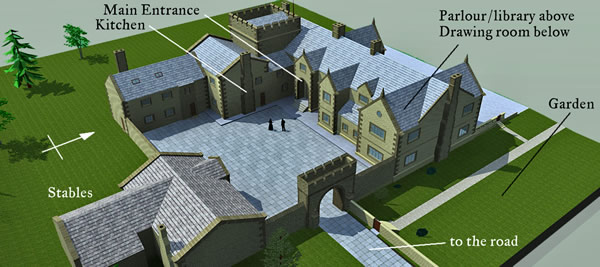
Wuthering Heights: the house
I recommend that you read first, always, and allow your imagination to form the image of character and place. Once that is established, then look at the images that others have created to suit their imaginations.
Visit http://www.wuthering-heights.co.uk/index.php for a source of Brontë’s life and times, the photos and locations of the actual places that likely inspired her, pronunciations, pertinent essays, and more.
Here is that author’s rendering of the layout of Wuthering Heights:

Wuthering Heights, xviii, xix
Twelve years beyond Cathy’s death.
“Catherine” now refers to the daughter: she is “the most winning thing that brought sunshine into a desolate house” (155), but is also saucy and petulant.
Catherine wants to wander beyond what is known, but her father forbids it for the avoidance of Heathcliff. One wonders why Ellen Dean did not suss the meaning of “crossing the Desert with caravan” (157).
Catherine Jr. attempts making Penistone Crags, but encountering Hareton near the Heights, and the unsuing dog battle, undoes the plan. A panicked Nell finds her at the house.
Catherine a wonderful time with Hareton until he tells her he’ll be damned to be her servant (157). She is further shocked to learn they are cousins. Hareton is described as althletic and healthy, “good things lost in a field of weeds” (161).
Edgar returns with a weak Linton who cries and cries. He’s not there a whole day before Joseph shows up, on behalf of Linton’s father Heathcliff, to claim him as parent and guardian.
Wuthering Heights, xvii
The ambiguity of Isabella:
“I’ve recovered from my first desire to be killed by him. I’d rather he’d kill himself! He has extinguished my love effectually, and so I’m at my ease. I can recollect yet how I loved him; and can dimly imagine that I could still be loving him, if – no, no!” (143).
“…I’d be glad of a retaliation that wouldn’t recoil on myself; but treachery and violence are spears pointed at both ends – they wound those who resort to them, worse than their enemies” (145).


 Kingsley Andersen