Home » Posts tagged 'Poetics' (Page 3)
Tag Archives: Poetics
Re-Imagining the Comprehensive High School
Re-Imagining the Comprehensive High School
What is the “authentic problem” of poetry?
Understanding Poetry: Mary Oliver, “West Wind #2”
Read this.
Yes — out loud.
By and by, I will examine you:
West Wind #2
Mary Oliver
You are young. So you know everything. You leap
into the boat and begin rowing. But listen to me.
Without fanfare, without embarrassment, without
any doubt, I talk directly to your soul. Listen to me.
Lift the oars from the water, let your arms rest, and
your heart, and heart’s little intelligence, and listen to
me. There is life without love. It is not worth a bent
penny, or a scuffed shoe. It is not worth the body of a
dead dog nine days unburied. When you hear, a mile
away and still out of sight, the churn of the water
as it begins to swirl and roil, fretting around the
sharp rocks – when you hear that unmistakable
pounding – when you feel the mist on your mouth
and sense ahead the embattlement, the long falls
plunging and steaming – then row, row for your life
toward it.
Understanding Poetry: Free verse
Simply, poetry that has no distinct meter. The poet is free to turn the line at his or her discretion.
Perhaps they feel it a natural pause, perhaps for emphasis, perhaps they want to emulate a conversational style. It is largely up to you to decide if this works.
Let me here step aside and offer an example from that great pioneer of vers libre, Walt Whitman. Some things to note as you read: if you count the syllables of the lines you see no set meter, but Whitman is indeed using sentences to communicate to us his opinion.
48
I have said that the soul is not more than the body,
And I have said that the body is not more than the soul;
And nothing, not God, is greater to one than one’s self is,
And whoever walks a furlong without sympathy, walks to his own funeral, drest in his shroud,
And I or you, pocketless of a dime, may purchase the pick of the earth,
And to glance with an eye, or show a bean in its pod, confounds the learning of all times,
And there is no trade or employment but the young man following it may become a hero,
And there is no object so soft but it makes a hub for the wheel’d universe,
And I say to any man or woman, Let your soul stand cool and composed before a million universes.
And I say to mankind, Be not curious about God,
For I, who am curious about each, am not curious about God;
(No array of terms can say how much I am at peace about God, and about death.)
I hear and behold God in every object, yet understand God not in the least,
Nor do I understand who there can be more wonderful than myself.
Why should I wish to see God better than this day?
I see something of God each hour of the twenty-four, and each moment then;
In the faces of men and women I see God, and in my own face in the glass;
I find letters from God dropt in the street—and every one is sign’d by God’s name,
And I leave them where they are, for I know that wheresoe’er I go,
Others will punctually come forever and ever.
49
And as to you Death, and you bitter hug of mortality, it is idle to try to alarm me.
To his work without flinching the accoucheur comes;
I see the elder-hand, pressing, receiving, supporting;
I recline by the sills of the exquisite flexible doors,
And mark the outlet, and mark the relief and escape.
And as to you, Corpse, I think you are good manure—but that does not offend me;
I smell the white roses sweet-scented and growing,
I reach to the leafy lips—I reach to the polish’d breasts of melons.
And as to you Life, I reckon you are the leavings of many deaths;
(No doubt I have died myself ten thousand times before.)
I hear you whispering there, O stars of heaven;
O suns! O grass of graves! O perpetual transfers and promotions!
If you do not say anything, how can I say anything?
Of the turbid pool that lies in the autumn forest,
Of the moon that descends the steeps of the soughing twilight,
Toss, sparkles of day and dusk! toss on the black stems that decay in the muck!
Toss to the moaning gibberish of the dry limbs.
I ascend from the moon, I ascend from the night;
I perceive that the ghastly glimmer is noonday sunbeams reflected;
And debouch to the steady and central from the offspring great or small.
50
There is that in me—I do not know what it is—but I know it is in me.
Wrench’d and sweaty—calm and cool then my body becomes;
I sleep—I sleep long.
I do not know it—it is without name—it is a word unsaid;
It is not in any dictionary, utterance, symbol.
Something it swings on more than the earth I swing on;
To it the creation is the friend whose embracing awakes me.
Perhaps I might tell more. Outlines! I plead for my brothers and sisters.
Do you see, O my brothers and sisters?
It is not chaos or death—it is form, union, plan—it is eternal life—it is HAPPINESS.
Understanding Poetry: Step 5
So, you are reading the poem, aware that a line is not necessarily a sentence – which is a complete thought.
If the line turns, you are still following the sentence,
Aware that many – but not all – poets capitalize
The first letter
Of the next line, and
That the sentence will stop. It might stop at any point
In the line. You follow the sentence,
Understand it
And when you comprehend the first.
You go to the second, understanding that and how
The first sentence informs the second and
The second the first,
Then you’re getting the verse! Get me?
Reading a sense poem is much the same as reading a paragraph, except the poet is going to dance the language; he or she will turn the line, slip in time, add color, shift from the literal to the figurative. It’s a mental challenge: are you up for it?
For the scholar-athlete or warrior-poet, explain that reading poetry is a sort of mental negotiation of an obstacle.
Understanding Poetry: Step 4
So you’ve determined that you’re reading a sense poem in which the author is trying to convey some meaning in the traditional sense of communicating to you in sentences.
Now, why does the poet turn the line at that point, whether or not the sentence has ended?
STEP 4: Is it a verse or free verse poem?
________________________
verse |vərs|
noun
writing arranged with a metrical rhythm, typically having a rhyme : a lament in verse | [as adj. ] verse drama.
• a group of lines that form a unit in a poem or song; a stanza : the second verse.
• each of the short numbered divisions of a chapter in the Bible or other scripture.
• a versicle.
• archaic: a line of poetry.
• a passage in an anthem for a soloist or a small group of voices.
verb [ intrans. ] archaic
speak in or compose verse; versify.
DERIVATIVES
verse•let |-lət| noun
ORIGIN Old English fers, from Latin versus ‘a turn of the plow, a furrow, a line of writing,’ from vertere ‘to turn’ ; reinforced in Middle English by Old French vers, from Latin versus.
_______________________
Verse comes from the literal turning of the plow or pen, and verse is guided largely by meter, which is measured language.
First we need to review some elements of speech, for poetry in ancient times was music without instruments, in which the voice provided the rhythm.
A syllable is a vowel sound usually conjoined with a consonant.
A vowel is an open vocal-tract sound,
a consonant is a closed vocal-tract sound.
(More on these later. The definitions are simplifications, I know, but bear in mind that I teach a clear review of what should be known – establishing foundation – and then I build upward in complexity to the student’s zone of proximal development.)
Most students get this: ask “How many syllables in ‘hippopotamus’?”
“Hi po pah tah mus – five!”
As an introduction to the “curve balls” of other languages – and to highlight why the word usually shows up so often in my definitions – I talk briefly about Hawaiian observations of the different nature of pyroclastic flow and introduce aa:
__________
aa |ˈäˌä|
noun Geology
basaltic lava forming very rough jagged masses with a light frothy texture. Often contrasted with pahoehoe .
ORIGIN mid 19th cent.: from Hawaiian ’a-‘a.
__________
Only a brief diversion: Welsh poetry comes much later.
So, how many syllables in “Johnny kicked the ball”?
Five. Good. And at this point you are speaking the lines, right? Because poetry is meant to be spoken.
(How many of you have read a poem over and over but have never spoken it? The act of forming the sound informs the meaning. Informs your being.)
How many syllables in “Shall I compare thee to a summer’s day?”
Good.
And in “Thou art more lovely and more temperate.”
Now might be a good time to show how that excellent tool the dictionary can guide us:
__________
temperate |ˈtemp(ə)rət|
adjective
1 of, relating to, or denoting a region or climate characterized by mild temperatures.
2 showing moderation or self-restraint : Charles was temperate in his consumption of both food and drink.
DERIVATIVES
tem•per•ate•ly adverb
tem•per•ate•ness noun
ORIGIN late Middle English (in the sense [not affected by passion or emotion] ): from Latin temperatus ‘mingled, restrained,’ from the verb temperare.
__________
And in “Rough winds do shake the darling buds of May”?
Ten and ten and ten; a pattern. A measurement. Meter.
And in verse, the sentence is most often turned prematurely to fit the meter.
Why meter? Because rhythm is pleasing, and may help us to remember the history and lore and science of our people in the centuries of oral tradition that thrived before the letter and the stylus.
If it’s a free verse poem, well, that’s another story.
Understanding Poetry: Steps 1 through 3
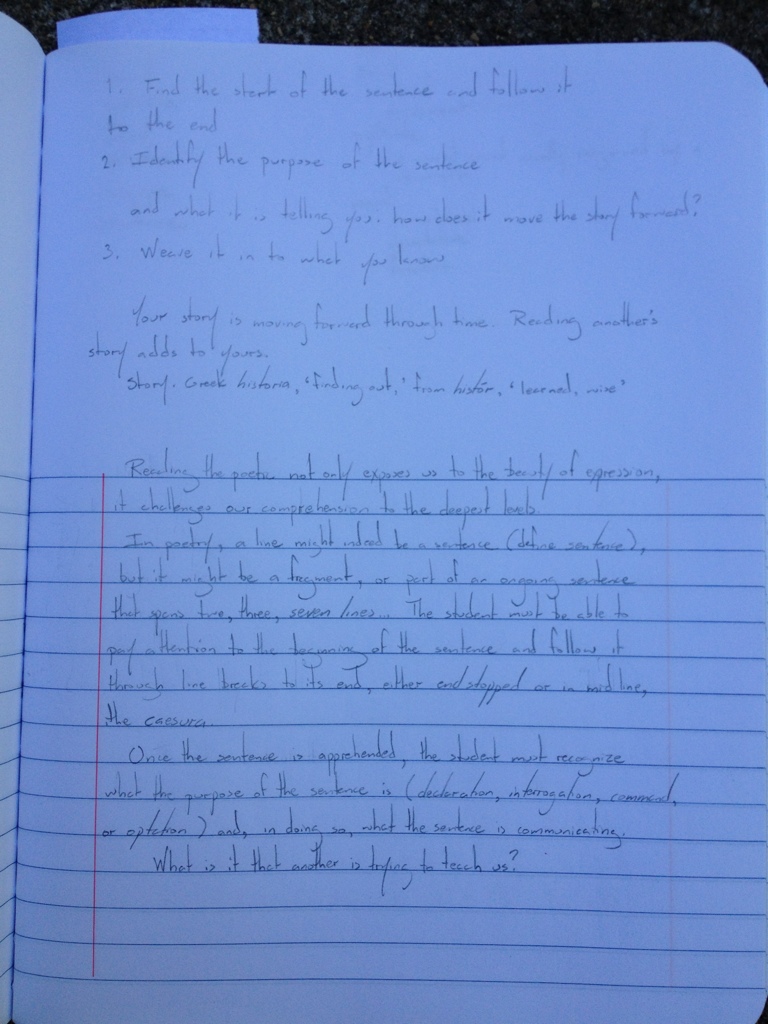
Step 1: Understand what a sentence is and the ways in which a sentence ends or is incomplete.
(You’d think this is obvious, but I can’t tell you how many readers get hung up on this step.)
Step 2: Realize that in poetry, the sentence may be part of a line, the whole line, more than a line, and perhaps several lines.
If the sentence stops within the line, this is called caesura.
End stop means the sentence ends at the line’s conclusion.
If the sentence goes on despite the line ending, this is called run on or enjambment.
IMPORTANT NOTE: Many poets practice the convention of capitalizing the first letter of each line regardless of whether this begins a new sentence. In my opinion, this worst of grammatical conventions confuses so many young readers. Be aware that in poetry capitalization does not necessarily indicate a new thought has begun.
Step 3: Apprehend whether the poem is a sense or a non-sense poem. (sic)
A sense poem is attempting to convey meaning to you in a more-or-less conventional form, such as a narrative or exposition. More on this later.
A non-sense poem may hint at sentences, but is not understandable in a conventional sense. A non-sense poem might play on shape or sound or an enigmatic hint at clear meaning.
Some examples of non-sense:
r-p-o-p-h-e-s-s-a-g-r |
||
| E.E. Cummings | ||
r-p-o-p-h-e-s-s-a-g-r who a)s w(e loo)k upnowgath PPEGORHRASS eringint(o- aThe):l eA !p: S a (r rIvInG .gRrEaPsPhOs) to rea(be)rran(com)gi(e)ngly ,grasshopper; |
||
Cummings is using the placement of letters to convey the skittish, wild hopping of the insect, but there is no sentence to this. We don’t attempt to elicit a meaning from this in the usual way. There is no message or moral.
Some poems hint at sentence structure, but again, sense does not appear to be the poet’s goal. Here, Louis Zukofsky translates Catullus not to bring the meaning into English, but to capture the song-like quality of the original Latin:
Catullus
Poem 41
Ameana pulling, a foot touted high,
touched me for all of ten thousand, and popped scut
is the tour-pickled, low-puling long nosed, ah
decocted heiress of the milked Formiani.
Propinquity, quick buss this fuel, cure eye,
amigos, medicos, call convocations:
no nest, she is nuts, pulls her neck, rogue harried,
what lies sit solid ice imagine o some.
As a rule, AP students are not likely to see non-sense poems as any major part of the examination. This doesn’t mean unconventional poetry has no worth and is to be glossed over: it means you apply a different lens.
Remember, the essential question is “What diction/tone/figures of speech does the author use to convey meaning?” We will spend many hours on this.
An abundance of poetic forms
Here’s a list of poetry type by ethnicity/nationality.
These are described in excellent book Shapes of Our Singing by Robin Skelton. The purpose of this post is to support the fact that almost every culture has a rich tradition of poetics.
If you know of another form, please comment.
Anglo-Saxon
Alliterative verse a la Eduard Sievers
Hazaj
Mutaquarib
Qasidah in the Basit
Rajaz
Sari
Tawil
Urjuzah
Wafir
Payar
Tripadi
Octosyllabic couplets
 Kingsley Andersen