Home » Uncategorized (Page 11)
Category Archives: Uncategorized
It’s like that.
Schoolsville
Billy Collins
Glancing over my shoulder at the past,
I realize the number of students I have taught
is enough to populate a small town.
I can see it nestled in a paper landscape,
chalk dust flurrying down in winter,
nights dark as a blackboard.
The population ages but never graduates.
On hot afternoons they sweat the final in the park
and when it’s cold they shiver around stoves
reading disorganized essays out loud.
A bell rings on the hour and everybody zigzags
into the streets with their books.
I forgot all their last names first and their
first names last in alphabetical order.
But the boy who always had his hand up
is an alderman and owns the haberdashery.
The girl who signed her papers in lipstick
leans against the drugstore, smoking,
brushing her hair like a machine.
Their grades are sewn into their clothes
like references to Hawthorne.
The A’s stroll along with other A’s.
The D’s honk whenever they pass another D.
All the creative-writing students recline
on the courthouse lawn and play the lute.
Wherever they go, they form a big circle.
Needless to say, I am the mayor.
I live in the white colonial at Maple and Main.
I rarely leave the house. The car deflates
in the driveway. Vines twirl around the porch swing.
Once in a while a student knocks on the door
with a term paper fifteen years late
or a question about Yeats or double-spacing.
And sometimes one will appear in a windowpane
to watch me lecturing the wallpaper,
quizzing the chandelier, reprimanding the air.
The Discovery of Poetry
The google ebook preview of Mayes’ book that is cited in the previous posts.
(You might notice page number citations on my handwritten notes, but I believe the pagination is different in the edition of the class set we use.)
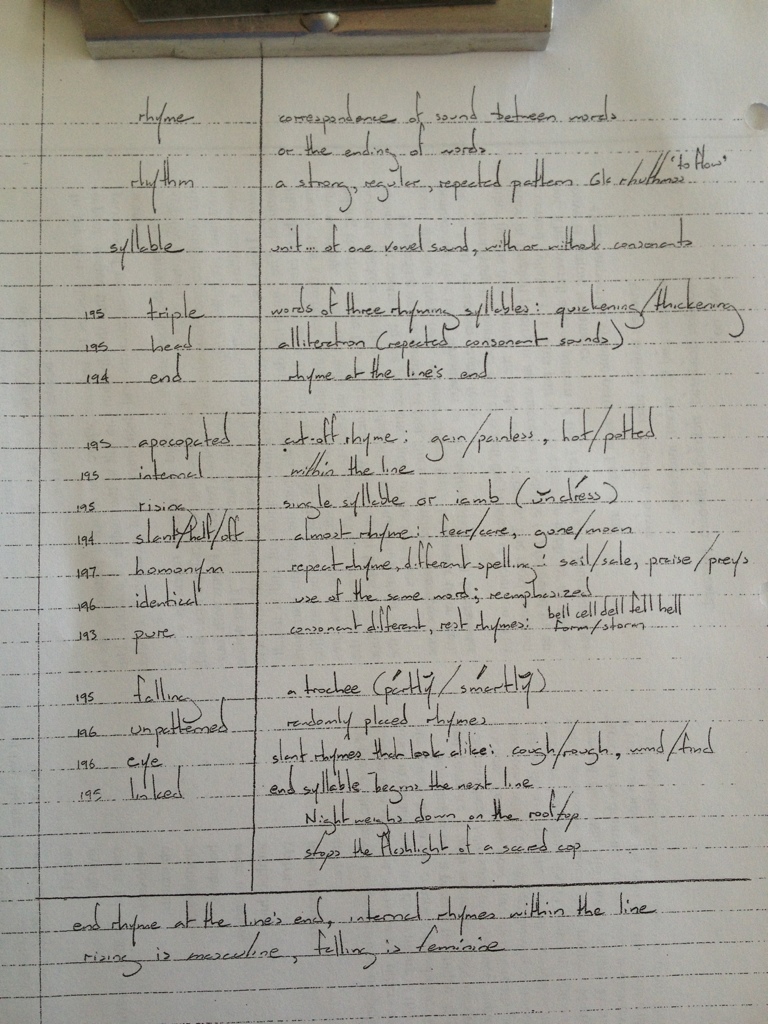
Understanding Poetry: rhyme
From the Oxford:
rhyme |rīm|
noun
correspondence of sound between words or the endings of words, esp. when these are used at the ends of lines of poetry.
• a short poem in which the sound of the word or syllable at the end of each line corresponds with that at the end of another.
• poetry or verse marked by such correspondence of sound.
• a word that has the same sound as another.
To simplify:
rhyme, the correspondence of sounds between words or the ending of words.
rhythm is a regular, repeated pattern, from the Greek rhuthmos, ‘to flow.’
To review:
syllable, a vowel sound usually conjoined to a consonant.
vowel, an open vocal-tract sound.
consonant, a closed vocal-tract sound.
Now, some examples. (Note that rhyme at the end of the line is only one of many types):
triple, words with three rhyming syllables, e.g., quickening/thickening
head, i.e., alliteration: “And the silken sad uncertain rustling of each purple curtain.”
end, rhyme at the line’s end
apocopated, a “cut-off”rhyme, e.g., hot/potted, pain/gainless
internal, rhyme within the line
rising, an iamb (syllables unstressed and stressed) or single stressed syllable at line’s end (see image below)
slant/half/off/approximate/near, an “almost” rhyme, e.g, fear/care, gone/moan
homonym, a repeated rhyme with different spelling, e.g., sail/sale, preys/praise
identical, or repetition, the same word, reemphasized
pure, rhyme with differing initial consonant: bell/cell/dell/fell/hell
falling, a trochee (syllables stressed and unstressed)(see image below.)
unpatterned, randomly-placed rhymes
eye, slant rhymes that look alike: cough/rough, wind/find
linked, end syllable of one line beginning the next, e.g.,
Night weighs down on the rooftop
stops the flashlight of a scared cop
The list is an adaptation of from
Mayes, Frances. The Discovery of Poetry. Harcourt. 2001.
The stressed or accented syllable is indicated by the ictus′ and the unstressed or unaccented syllable by the breve˘

Script excerpt
Now, devotees may argue that one sport
or game is inherently better than
another. For me, sport is actually a
chance for us to have other human beings
push us to excel. I want you all to come
over here and take a slip of paper and
line up single file.
Keating reaches the stands. He tosses the balls aside and pulls sets
his briefcase down. As the boys line up he begins ripping off slips
of paper from a notepad and handing them out.
KEATING
Mr. Meeks, time to inherit the earth.
Mr. Pitts, rise above your name.
He hands the notepad to another student.
KEATING
I want you to hand these out to the boys,
one apiece.
EXT. SOCCER FIELD – DAY
The students are all lined up in single file, each holding a slip
of paper. Keating blows his whistle.
KEATING
You know what to do, Pitts.
PITTS
“Oh to struggle against great odds. To
meet enemies undaunted.”
KEATING
Sounds to me like you’re daunted. Say it
again like you’re undaunted.
PITTS
“Oh to struggle against great odds. To
meet enemies undaunted.”
KEATING
Now go on.
Pitts gives one of the soccer balls a good kick.
KEATING
Yes! Next.
One of the students sets up the next ball as the line advances.
BOY 1
“To be a sailor of the world, bound for
all ports.”
KEATING
Next. Louder!
BOY 2
“Oh, I live to be the ruler of life, not
a slave.”
Keating walks away and starts up a record player.
BOY 3
“To mount the scaffolds. To advance to
the muzzle of guns with perfect
nonchalance.”
Classical music begins playing on the phonograph. Meeks goes to
read next but is confused by the music.
KEATING
Come on, Meeks! Listen to the music.
MEEKS
“To dance, clap hands, exalt, shout,
skip, roll on, float on.”
KEATING
Yes!
HOPKINS
(without energy)
“Oh, to have life henceforth the poem of
new joys.”
Hopkins crumples up his paper and then barely taps the soccer
ball with his foot.
Keating puts a look of disgust on his face.
KEATING
Oh! Boo! Come on, Charlie, let it fill
your soul!
Charlie raises his hands over his head.
CHARLIE
“To indeed be a god!”
By the act of reading…
…you enter the long black branches of other lives.

Poetry: Have You Ever Tried to Enter the Long Black Branches (post 1 of 2)
COMMENTARY:
1. This is a Mary Oliver poem I cut-and-pasted from the internet.
One of the disservices that comes from this practice is that you are “taking the word” of the blogger or the site from which you find the poem that the author’s punctuation and presentation has been faithfully honored. (That this punctuation is crucial is something you should be becoming increasingly aware of.)
Well, make sure you see the google ebook of this poem, because the punctuation and presentation here is waaaaaaaaaaaaaaaay off.
2. She approaches Whitman’s “Song of Myself” in this.
3. Young people! Do NOT leave your desk for long: right now you are in the process of provisioning yourself for the journey of life. Understand this deeply.
Have You Ever Tried to Enter the Long Black Branches
Mary Oliver
Have you ever tried to enter the long black branches of other lives —
tried to imagine what the crisp fringes, full of honey, hanging
from the branches of the young locust trees, in early morning, feel like?
Do you think this world was only an entertainment for you?
Never to enter the sea and notice how the water divides
with perfect courtesy, to let you in!
Never to lie down on the grass, as though you were the grass!
Never to leap to the air as you open your wings over the dark acorn of your heart!
No wonder we hear, in your mournful voice, the complaint
that something is missing from your life!
Who can open the door who does not reach for the latch?
Who can travel the miles who does not put one foot
in front of the other, all attentive to what presents itself
continually?
Who will behold the inner chamber who has not observed
with admiration, even with rapture, the outer stone?
Well, there is time left —
fields everywhere invite you into them.
And who will care, who will chide you if you wander away
from wherever you are, to look for your soul?
Quickly, then, get up, put on your coat, leave your desk!
To put one’s foot into the door of the grass, which is
the mystery, which is death as well as life, and
not be afraid!
To set one’s foot in the door of death, and be overcome
with amazement!
To sit down in front of the weeds, and imagine
god the ten-fingered, sailing out of his house of straw,
nodding this way and that way, to the flowers of the
present hour,
to the song falling out of the mockingbird’s pink mouth,
to the tippets of the honeysuckle, that have opened
in the night
To sit down, like a weed among weeds, and rustle in the wind!
Listen, are you breathing just a little, and calling it a life?
While the soul, after all, is only a window,
and the opening of the window no more difficult
than the wakening from a little sleep.
Only last week I went out among the thorns and said
to the wild roses:
deny me not,
but suffer my devotion.
Then, all afternoon, I sat among them. Maybe
I even heard a curl or tow of music, damp and rouge red,
hurrying from their stubby buds, from their delicate watery bodies.
For how long will you continue to listen to those dark shouters,
caution and prudence?
Fall in! Fall in!
A woman standing in the weeds.
A small boat flounders in the deep waves, and what’s coming next
is coming with its own heave and grace.
Meanwhile, once in a while, I have chanced, among the quick things,
upon the immutable.
What more could one ask?
And I would touch the faces of the daises,
and I would bow down
to think about it.
That was then, which hasn’t ended yet.
Now the sun begins to swing down. Under the peach-light,
I cross the fields and the dunes, I follow the ocean’s edge.
I climb, I backtrack.
I float.
I ramble my way home.
Poetry: Genius Child
Genius Child
Langston Hughes
This is a song for the genius child.
Sing it softly, for the song is wild.
Sing it softly as ever you can –
Lest the song get out of hand.
Nobody loves a genius child.
Can you love an eagle,
Tame or wild?
Can you love an eagle,
Wild or tame?
Can you love a monster
Of frightening name?
Nobody loves a genius child.
Kill him – and let his soul run wild.

 Kingsley Andersen